Green pots: recycle, create & grow.
A Project-Based Learning Experience for Environmental Stewardship
Transform everyday waste into living learning.
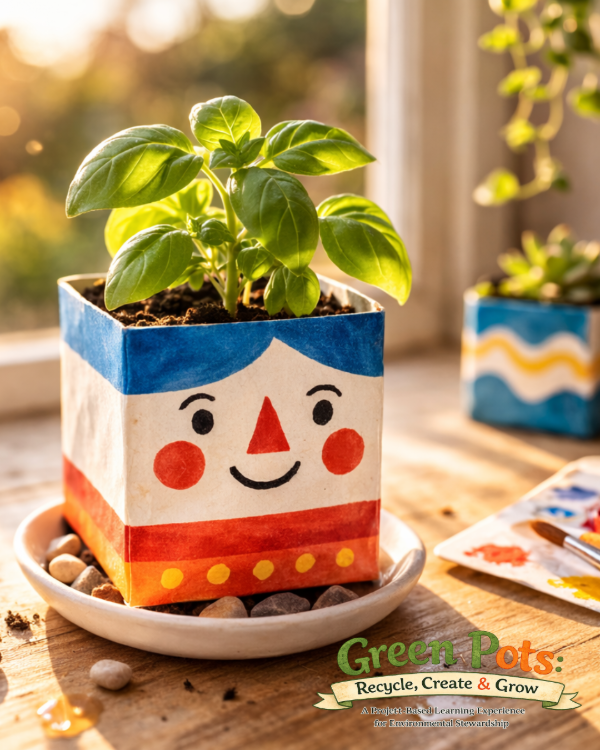
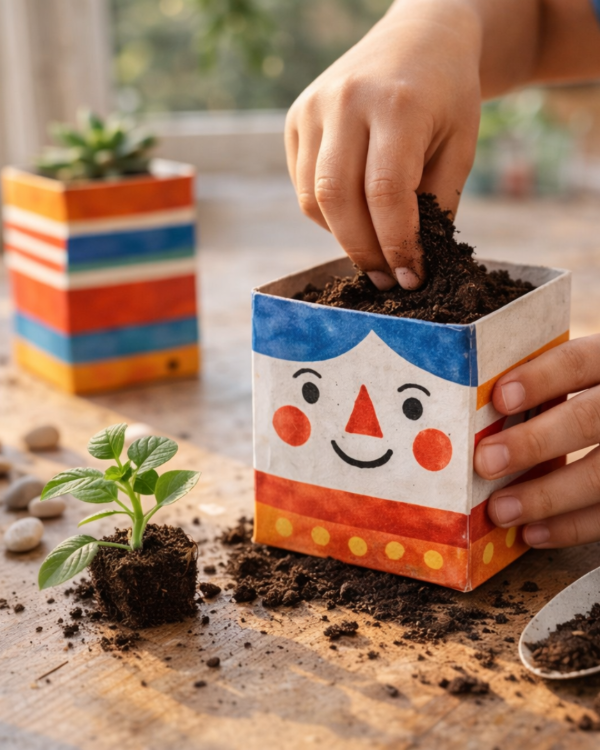
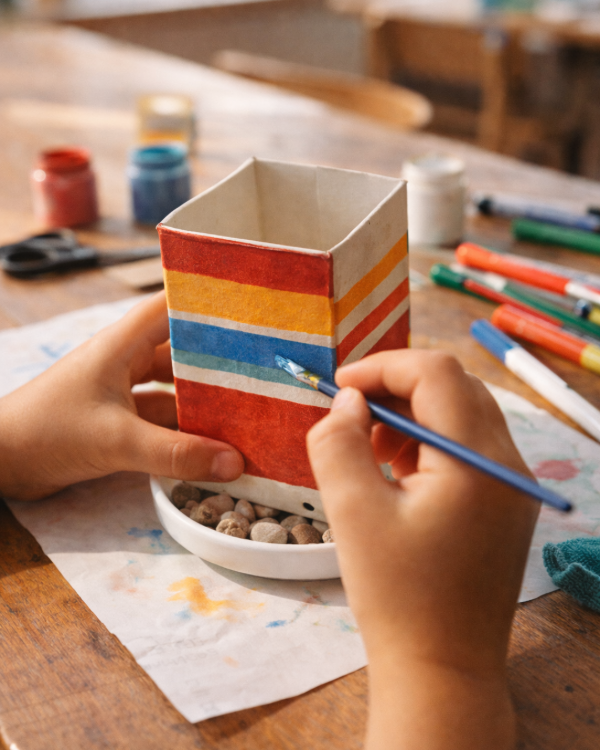
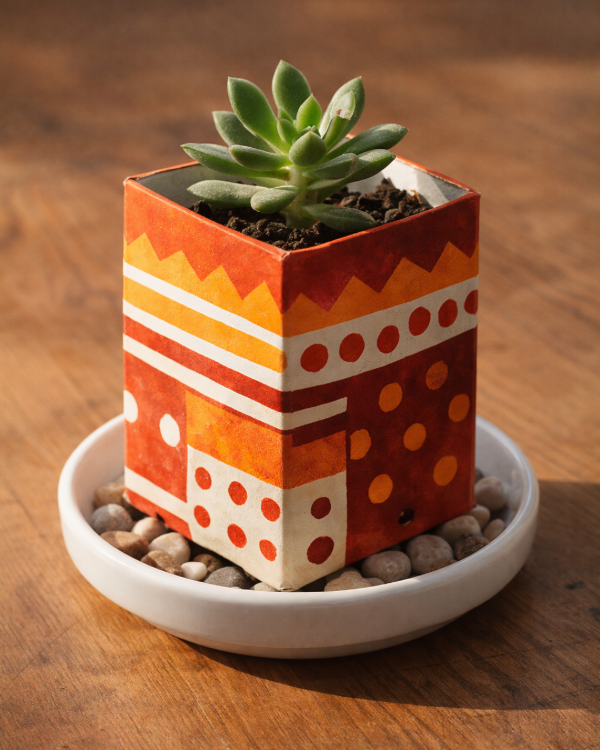
Green Pots is a complete, cross-curricular project designed for Primary students (ages 6–12) that integrates environmental education, creativity, and scientific inquiry through a meaningful hands-on experience: turning recycled milk cartons into personalized plant pots.
Grounded in Project-Based Learning and aligned with STEAM principles, this resource invites students to move from reflection to action. Over three carefully structured 90-minute sessions, children explore the concept of recycling and the circular economy, design and decorate their own plant pot, and commit to nurturing a living plant while documenting its growth.
This is not a craft activity. It is a pedagogical sequence that positions students as protagonists of their learning while fostering responsibility, aesthetic expression, and ecological awareness.
What makes this resource powerful?
The project is built upon constructivist and experiential learning principles. Students connect recycling to their everyday lives, collaborate within their Zone of Proximal Development, and learn by doing, reflecting, and applying knowledge in a tangible way.
The learning objectives are comprehensive and developmentally thoughtful:
Students develop environmental awareness and understand the impact of recycling.
They identify plant parts and needs while learning basic concepts such as drainage, potting mix, and photosynthesis.
They follow sequential instructions, use tools safely, and create original artistic compositions.
They practice observation and record plant growth through a structured Growth Journal.
They cultivate responsibility, teamwork, and long-term commitment through a one-month Plant Care Pledge.
What’s included?
• A complete 3-session learning sequence (Explore & Prepare, Create & Decorate, Plant & Commit)
• Clear step-by-step procedures.
• Discussion prompts and driving questions.
• Growth Journal and reflection tools.
• A detailed assessment rubric (environmental awareness, artistic expression, plant care, teamwork, and more)
• Differentiation strategies for ages 6–12.
• Inclusion adaptations for diverse learners.
• Cross-curricular extensions (Science, Math, Language Arts, Visual Arts,
• A complete 3-session learning sequence (Explore & Prepare, Create & Decorate, Plant & Commit)
• Clear step-by-step procedures
• Discussion prompts and driving questions
• Growth Journal and reflection tools
• A detailed assessment rubric (environmental awareness, artistic expression, plant care, teamwork, and more)
• Differentiation strategies for ages 6–12
• Inclusion adaptations for diverse learners.
• Cross-curricular extensions (Science, Math, Language Arts, Visual Arts,
Assessment is formative and process-oriented, valuing engagement, reflection, and growth over technical perfection.
Flexible and low-Cost .
All materials are accessible and eco-conscious. The project prioritizes reused household materials and offers sustainable alternatives, making it ideal for any classroom setting.
Curriculum connections.
Natural Sciences: plant life cycle, urban ecosystems, photosynthesis.
Mathematics: measuring growth, calculating rates, graphing data.
Language Arts: procedural writing, journaling, storytelling.
Visual Arts: pattern design, personal symbolism, installation projects.
Environmental Education: school-wide recycling initiatives.
Green pots: recycle, create and grow.
$5.000,00
Green pots: recycle, create & grow.
A Project-Based Learning Experience for Environmental Stewardship
Transform everyday waste into living learning.
Green Pots is a complete, cross-curricular project designed for Primary students (ages 6–12) that integrates environmental education, creativity, and scientific inquiry through a meaningful hands-on experience: turning recycled milk cartons into personalized plant pots.
Grounded in Project-Based Learning and aligned with STEAM principles, this resource invites students to move from reflection to action. Over three carefully structured 90-minute sessions, children explore the concept of recycling and the circular economy, design and decorate their own plant pot, and commit to nurturing a living plant while documenting its growth.
This is not a craft activity. It is a pedagogical sequence that positions students as protagonists of their learning while fostering responsibility, aesthetic expression, and ecological awareness.
What makes this resource powerful?
The project is built upon constructivist and experiential learning principles. Students connect recycling to their everyday lives, collaborate within their Zone of Proximal Development, and learn by doing, reflecting, and applying knowledge in a tangible way.
The learning objectives are comprehensive and developmentally thoughtful:
Students develop environmental awareness and understand the impact of recycling.
They identify plant parts and needs while learning basic concepts such as drainage, potting mix, and photosynthesis.
They follow sequential instructions, use tools safely, and create original artistic compositions.
They practice observation and record plant growth through a structured Growth Journal.
They cultivate responsibility, teamwork, and long-term commitment through a one-month Plant Care Pledge.
What’s included?
• A complete 3-session learning sequence (Explore & Prepare, Create & Decorate, Plant & Commit)
• Clear step-by-step procedures.
• Discussion prompts and driving questions.
• Growth Journal and reflection tools.
• A detailed assessment rubric (environmental awareness, artistic expression, plant care, teamwork, and more)
• Differentiation strategies for ages 6–12.
• Inclusion adaptations for diverse learners.
• Cross-curricular extensions (Science, Math, Language Arts, Visual Arts,
• A complete 3-session learning sequence (Explore & Prepare, Create & Decorate, Plant & Commit)
• Clear step-by-step procedures
• Discussion prompts and driving questions
• Growth Journal and reflection tools
• A detailed assessment rubric (environmental awareness, artistic expression, plant care, teamwork, and more)
• Differentiation strategies for ages 6–12
• Inclusion adaptations for diverse learners.
• Cross-curricular extensions (Science, Math, Language Arts, Visual Arts,
Assessment is formative and process-oriented, valuing engagement, reflection, and growth over technical perfection.
Flexible and low-Cost .
All materials are accessible and eco-conscious. The project prioritizes reused household materials and offers sustainable alternatives, making it ideal for any classroom setting.
Curriculum connections.
Natural Sciences: plant life cycle, urban ecosystems, photosynthesis.
Mathematics: measuring growth, calculating rates, graphing data.
Language Arts: procedural writing, journaling, storytelling.
Visual Arts: pattern design, personal symbolism, installation projects.
Environmental Education: school-wide recycling initiatives.